Nabadurga
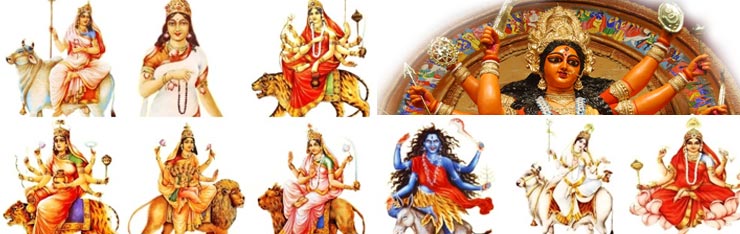
1. SAILAPUTRI
Goddess Durga’s first form amongst the nine is Sailaputri. She was nomenclatured as Sailaputri after being born in the house of the king of the mountains, Himalaya. In this mold the mother is seen holding a trident in her right hand and a lotus in her left and she is mounted on an ox. In the past life she was the daughter of Daksha, the son of Lord Brahma.
She was known as Sati then. As the daughter of Daksha she was married to the God of Gods, Mahadeva. Daksha once arranged for a ceremony of the holy fire (Yagna), and chose not to invite his daughter and son-in-law. Sati was restless to join the ceremony at her father’s place and even defied her husband’s advice of not attending the Yagna without an invitation. On going uninvited to the ceremony, she felt that everyone was giving her a cold shoulder except her mother who greeted her with a hug. Her siblings too were no exception and were sarcastic in their remarks. The guests too present in the function were uttering disrespectful comments about her husband. To her surprise her father too was harsh and rude in his approach. She was dejected and was so heart broken that she burnt herself to ash in the holy fire. Shiva, on hearing this incident was enraged and ordered his followers to immediately demolish the Daksha Yagna.
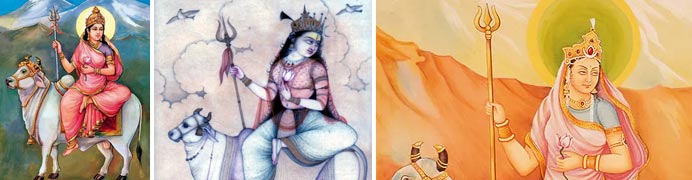
After burning herself to death, Sati was reborn as the daughter of the king of the mountains, Himalaya and became known as Sailaputri. Thus amongst all the nine forms of Devi Durga, Sailaputri is the most powerful and glorified of all. She is worshiped in the first day of the Navratri celebrations. According to the Upanishads this form of Durga broke the pride of the Gods by assuming the mold of Haimabati.
2. BRAHMACHARINI
Durga’s second appearance is in the form of Brahmacharini. Here "Brahma" means meditation. That is, the Goddess is the meditator or a practitioner of penance. She is seen here holding a string of rosary beads in her right hand and a Kamandul (an urn containing holy water) in her left hand. In her previous life, when she was reborn as the daughter of Himalaya, she performed severe penance to have Mahadeva as her husband. The sage God Narad advised her to take up meditation to win Shiva. For undergoing strict meditation she was known as Brahmacharini or Tapasyacharini.
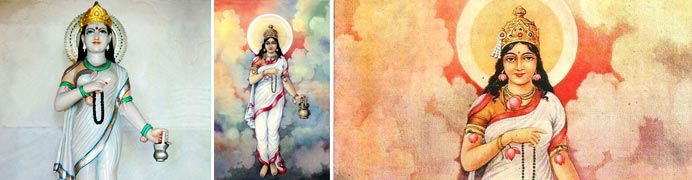
Ignoring the beating sun and thundershowers, she began a three hundred year meditation living only on wood apple leaves that fell on the forest floor. She furthered her penance making it even stricter by relinquishing food and water for another few hundred years. As she gave up eating leaves she is also referred to as “Aparna”. Practicing this painstaking contemplation she became weak and skinny. Unable to withstand the plight of her daughter her mother, Manoka requested her to give up her resolution. Shocked at the sight of Durga she exclaimed “ U ma! Na aar naa”. That is why Durga is also called “Uma”. On the other hand overwhelmed by Durga’s devotion and perseverance, all the Gods and sages in the heaven were placated. At last, grandfather Brahma, pleased with devi’s austerities made an oracle, “O maiden! No one could achieve or endure the penance you have performed till date. I am captivated by your meditation and devotion. Your wish will be fulfilled and you will certainly have Shiva as your husband. You may now return home and rest. Your father will come soon to take you.” This form of Durga gives the devotees everlasting success. Worship of this appearance enriches the faculties of sacrifice, honesty and self-discipline. In times of utter distress the worship of this form gives success and the willpower to come out victorious. This form of Durga is worshiped in the second day of the Durga puja.
3. CHANDRAGHANTA
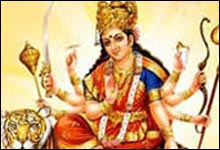
Mother Durga’s third form is known as Chandraghanta. This name finds its justification in the half moon seen on the temple of the Goddess that resembles a bell. The deity has ten arms. The ten hands of the Goddess brandish ten different weapons. Mounted on a lion this form of the mother is worshiped on the third day of the Navratri celebration. It is believed that a devotee who manages to earn the devi’s blessings can set himself free from his sins and hazards that he has committed or may face in his life. The devotee gains the power to sense the supernatural, to see it and even smell the eternal fragrance.
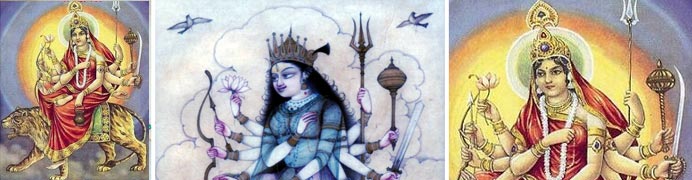
He is also able to distinguish the otherwise inaudible celestial sounds. This is the time when the devotee should be alert. Although the deity is always envisaged in the fearsome mood of demolishing the evil, her appearance always spreads a calm and eternal peace all round. Mother Chandraghant’s devotees spread peace and happiness wherever they go. We should all whole-heartedly worship the mother with a devoted soul. Worship of the deity helps one eliminate the sorrow, hazards and dangers in ones life.
4. KUSHMANDA
The fourth appearance of the devi is in the form of Kushmanda. The mother gets the name as she created the universe with a smile. When there was darkness everywhere and there was no existence of the universe she created the universe with a smile. She is believed to be the source of eternal power. The Goddess has eight arms and that is why she is also known as “Astabhuja”. The deity’s seven hands hold the holy urn (Kamandul), a bow, an arrow, a lotus, a pot containing nectar, a disc and a club. The eighth hand holds a string of rosary beads that is believed to provide success and prudence.Pumpkin is termed as “Kushmando” in Sanskrit.
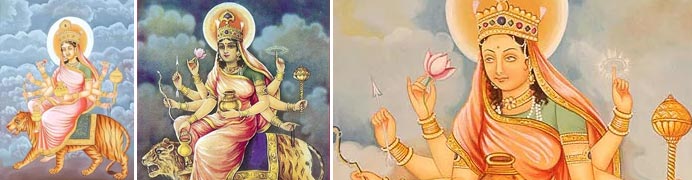
Amongst the sacrificial vegetables that are offered in the worship of the Goddess (naibidhya), pumpkin is the most important vegetable with which Devi Kushmanda is most placated. That is why she is named “Kushmanda”. She is worshiped on the fourth day of the Navratri celebration abiding by the rituals that are described in the Sashtra and the Purans. Worship of this form of the Devi exterminates sorrow and diseases and augments life, fame and strength. Mother Goddess is appeased with the slightest of devotion and if any one whole-heartedly worships the deity he will certainly gain her favour.